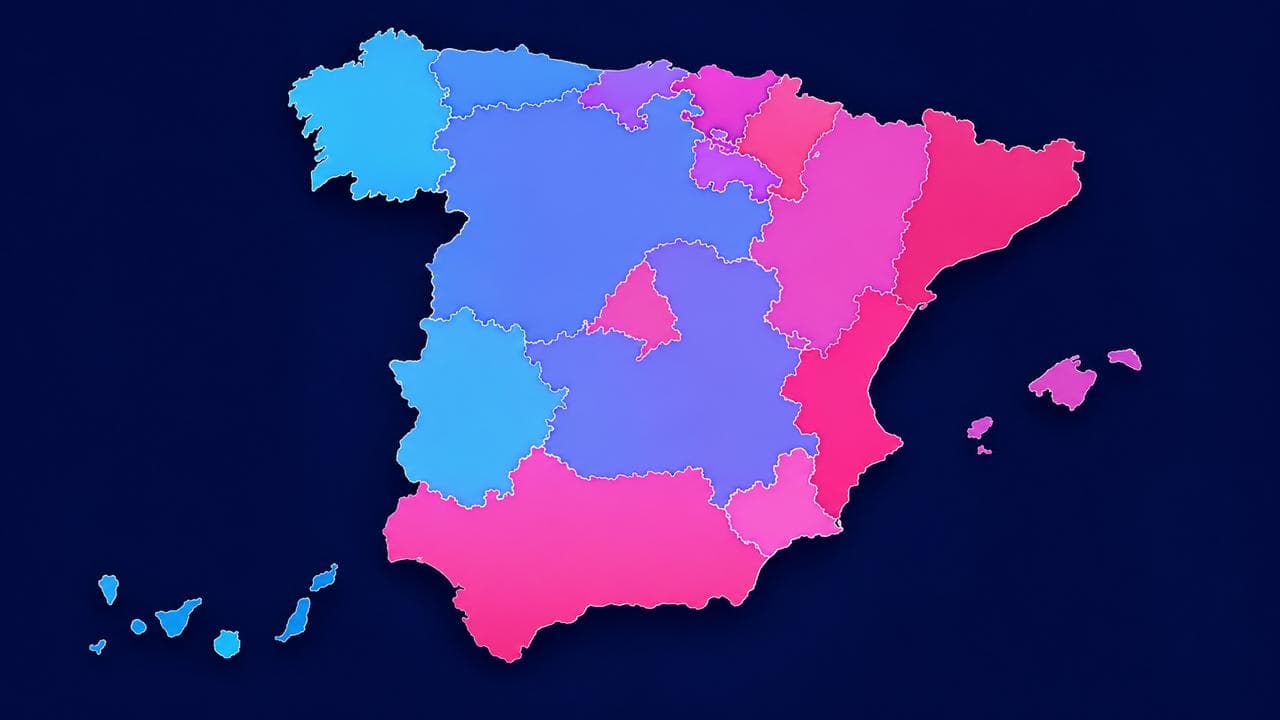
The listed price is not the final cost. In Spain, a buyer typically adds between 8% and 13% to the property price to cover taxes and transaction fees. On a property worth €200,000, this represents an additional €16,000 to €26,000 on top of the initial deposit. This wide range is due to a specific reason: the main tax rate depends on the autonomous community where the property is located, and it can vary significantly from one region to another.
How much tax do you pay when buying a home in Spain?
For existing properties, the buyer pays a transfer tax ranging from 4% to 13% of the price, depending on the autonomous community. For new properties, they pay 10% VAT plus a stamp duty of 0.5% to 1.5%. The two systems are mutually exclusive: you pay one or the other, never both.
The transfer tax is called ITP, short for Impuesto sobre Transmisiones Patrimoniales (Tax on Transfers of Assets). It is a state tax, the administration and rate of which have been transferred to the autonomous communities. The rate therefore depends on the property's location, not your place of residence. A buyer from Germany, Madrid, or Switzerland pays the same rate for an apartment located in Valencia.
The buyer pays the capital gains tax. The seller is responsible for the municipal capital gains tax and the tax on their own capital gains. The settlement is made using form 600, with the tax office of the municipality where the property is located, within thirty working days of signing the deed. After this period, a surcharge is applied, followed by late payment interest.
The community-by-community transfer tax rate in 2026
Here are the general rates applicable to the purchase of an existing home. Several communities apply a tiered scale, similar to income tax: the higher rate only applies to the portion of the price that exceeds each threshold.
Autonomous Community | General rate 2026 | Main reduced rates |
|---|---|---|
Basque Country | 4% | 2.5% of large families in Biscay |
Madrid | 6% | 4% large families |
Navarre | 6% | 5% of families with children |
Ceuta and Melilla | 6% | not applicable |
Canary Islands | 6.5% | 5% primary residence, 1% under 40 years old |
Andalusia | 7% | 6% up to €150,000, 3.5% for those under 35 |
La Rioja | 7% | 4% under 40 years old, 3% in rural areas |
Aragon | 8% to 10% | 50% to 60% tax reduction for large families |
Asturias | 8% to 10% | 4% to 6% young people, 3% sheltered housing |
Galicia | 8% | 7% primary residence, 4% rural rehabilitation |
Murcia | 8% | 3% under 40 years old, 4% sheltered housing |
Castile and León | 8%, 10% above €250,000 | 4% under 36 years old, 0.01% in rural areas |
Extremadura | 8% to 11% | 7% main residence, 4% sheltered housing |
Balearic Islands | 8% to 13% | 0% first-time home purchase for those under 30 |
Cantabria | 9% | 7% primary residence, 4% young people |
Castile-La Mancha | 9% | 6% first residence, 5% young people |
Valencian Community | 9%, 11% above €1 million | 6% under 35 years old, 3% large families |
Catalonia | 10% to 13% | 5% under 35 years old, 20% large shareholders |
Two recent developments are changing the game. Catalonia switched to a progressive tax scale on June 27, 2025, with Decree-Law 5/2025: 10% up to €600,000, 11% between €600,000 and €900,000, 12% between €900,000 and €1,500,000, and 13% above that. The same legislation created a 20% rate for owners of more than ten properties. The Valencian Community did the opposite on June 1, 2026: the general rate was reduced from 10% to 9%, and the stamp duty from 1.5% to 1.4%.
The taxable base is not the price you pay.
This is the point that surprises the most buyers. Since Law 11/2021, the tax is not calculated on the price stated in the deed, but on the higher of two amounts: this price, or the reference value that the General Directorate of Cadastre publishes each year for each property.
An example makes the mechanics clear. You negotiate an apartment for €150,000. Its cadastral reference value is €170,000. In a community with a 10% tax rate, you don't pay €15,000 in taxes but €17,000. Negotiating well doesn't reduce the tax bill.
The reference value can be consulted free of charge on the land registry website, using a digital certificate or Cl@ve. Do this before signing the deposit agreement, not after. If it exceeds the negotiated price, your tax bill will increase unavoidably, unless you contest the value with a supporting expert appraisal.
New or old: two different tax regimes
Situation | Applicable tax | Rate |
|---|---|---|
Old property sold by a private individual | ITP | 4% to 13% depending on the community |
New housing sold by the developer | VAT plus stamp duty | 10% plus 0.5% to 1.5% |
Protected housing under special regime | Reduced VAT | 4% |
Purchase in the Canary Islands | IGIC instead of VAT | specific island regime |
In new builds, stamp duty is always added to VAT and remains the responsibility of the buyer. This is a difference that many comparisons overlook: the total tax burden on a new home is around 11%, placing it above Madrid and below Catalonia.
Additional fees beyond those paid on top of taxes
These amounts are smaller than the tax, but they are cumulative. Notary fees follow an official scale set by Royal Decree 1426/1989: the base fee is modest, and the actual bill rises to between 600 and 900 euros once copies, advance payments, and VAT are added. Registration in the land registry costs between 300 and 650 euros. The land registry office (gestoría), which handles the tax payments and files the deed, charges between 300 and 500 euros. The property appraisal, mandatory only if you are taking out a loan, costs around 400 euros.
Since Law 5/2019 on mortgage loans, the bank assumes the costs associated with the mortgage: loan notary fees, registration of the guarantee, and loan stamp duty. Verify this line item in the statement of funds requested by the mortgage administrator.
The same apartment at 200,000 euros costs 8,000 euros more to buy in Catalonia than in Madrid, at the same selling price.
What changes when you buy from abroad
Two issues keep coming up among non-resident buyers. The first is a persistent rumor. The second is a real obligation that many discover too late.
A 100% tax is not a law
On January 13, 2025, the Spanish government announced a package of twelve housing measures. One of these measures created a supplementary state tax of up to 100% of the property value for non-resident buyers outside the European Union. The bill was submitted to Congress on May 22, 2025. By the end of March 2026, more than ten months later, it had still not been debated in session. No version had been passed, and the January 2026 housing package did not include it.
The text, if adopted as is, would only apply to non-residents outside the European Union. German, Dutch, French, Italian, and Polish nationals would be excluded. It would also not apply to new properties sold by developers, since such sales are subject to VAT, which is harmonized at the European level.
The 3% withholding tax applies when the seller is a non-resident.
This rule exists and it concerns you as the buyer. If the seller is not a tax resident of Spain, you must withhold 3% of the agreed price and pay it to the tax authorities using form 211 within one month of signing. This is not an additional cost: the amount is deducted from the price paid to the seller, who then recovers it through their own tax return.
If you don't withhold this 3%, the property itself is liable for the tax debt, even if the seller has left the country. Always ask the seller for a tax residency certificate. Without this document, withhold and declare the tax.
What you pay each year afterwards
Municipal property tax, condominium fees, and home insurance apply to all property owners. An additional obligation falls on non-residents, and it is the least known.
A non-resident who owns a property in Spain must declare a notional income each year, even if the property remains empty and generates no revenue. This income is 1.1% of the cadastral value if it has been revised within the last ten years, or 2% otherwise. It is taxed at 19% for residents of the European Union, Iceland, Norway, and Liechtenstein, and at 24% for all others, including the United Kingdom, the United States, and Switzerland. The declaration is made using form 210.
A concrete example: a recently revised cadastral value of €120,000 results in an imputed income of €1,320. For a property owner residing outside the European Union, the annual tax amounts to €316.80. The amount remains modest, but failure to declare results in a penalty, and the land registry transmits its data to the tax authorities.
How InvestPilot reads it
Acquisition costs aren't just an administrative line item. They affect the amount you need to set aside, the cost price of your property, and the return on investment you'll make. Here's how they impact each buying strategy.
Strategy | Concerned | Concrete impact |
|---|---|---|
Primary residence | Yes | Reduced rates for those under 35 and large families are checked before the deposit contract, not at the time of settlement. |
Second home | Yes | No reduced rate applies, and the imputed income is returned each year even when the property remains empty. |
Long-term rental | Yes | The costs are included in the cost price and reduce the net return in the first year. |
Short-term rental | Partial | The same effect is had on the cost price, to which are added the obligations specific to the rental activity. |
Renovation and resale | Yes | The tax paid on the purchase is added to the cost of the work, and the margin is calculated after the resale tax. |
InvestPilot's calculation of financial capacity incorporates these costs from the outset, using the actual interest rate of the community where the property is located. This represents the difference between a theoretical budget and the amount the bank and notary will charge you.