
Buying a house in Spain as a UK buyer follows the same legal path as for a Spanish buyer. You get an identification number, check the home on paper, sign a private contract, sign a deed before a notary and register it. What changes is tax: since Brexit, UK residents are taxed in Spain as non-EU owners. This guide follows that order, using official rules checked in October 2026. Many figures depend on the region, so each one says where it applies.
Before you sign anything: the NIE and checks on the home
The NIE (número de identidad de extranjero, the foreigner's identity number) is the personal number Spain gives to foreigners who deal with the country for economic reasons, such as buying a home (Real Decreto 1155/2024, art. 205, in force since 20 May 2025). It is not issued automatically: you apply and state your reason. In Spain you apply in person to the National Police, at an immigration office or a police station; from the UK, through a Spanish consulate.
The National Police e-office asks for form EX15 and proof of payment of fee 790 code 012. The official fee form showed €9.84 in October 2026. The police must decide within five days, and no reply in that time counts as a refusal. Our guide NIE number in Spain: what it is for, how to get one and how long it takes covers the practical side.
Why it matters: for a foreign individual, the tax identification number (NIF) is the NIE (Real Decreto 1065/2007, art. 20), and the Land Registry will not register a purchase deed unless the tax numbers of everyone signing it appear in it (Ley Hipotecaria, art. 254). In practice, have your NIE well before completion.
Three documents to look at early
- Nota simple (Land Registry extract). It shows the property, its owner and any charges, such as a mortgage. Through the Colegio de Registradores platform it costs €9.02 plus VAT (price shown for a Madrid registry in October 2026), arrives in under two hours on average and can be ordered in English. It is for information only and does not certify the register entries (Ley Hipotecaria, art. 222).
- Valor de referencia (the Catastro reference value), the minimum base for transfer tax. The Catastro shows it in its e-office once you identify yourself with DNI details, a digital certificate or Cl@ve.
- Certificado de eficiencia energética (energy performance certificate), compulsory when an existing home is sold (Real Decreto 390/2021). A registered copy and the label are annexed to the sale contract (art. 17). It is valid for up to ten years, or five if rated G (art. 13).
In Catalonia, the seller must also hand over a valid cédula de habitabilidad (habitability certificate), including for second-hand homes, and the notary must ask for it before authorising the sale (Catalan Law 18/2007, arts. 26 and 132).
From reservation to keys: the steps in order
- Private contract and deposit (arras). Under article 1454 of the Civil Code, where arras have been paid, the buyer can withdraw by losing the deposit and the seller by repaying it twice over. Ask your lawyer which rule your contract actually sets, because the wording decides it.
- Mortgage, if you need one. The bank must give you the FEIN (binding offer), the FiAE (standardised warnings) and the draft contract at least ten calendar days before signing (Ley 5/2019, art. 14). By the day before signing at the latest, you see a notary of your choice for advice and sign a preliminary record, free of charge (art. 15). See Mortgages for non-residents in Spain 2026.
- Escritura (public deed) before a notary. A transfer of ownership of a property must be in a public document (Civil Code, art. 1280), and signing the deed counts as handing over the home unless the deed says otherwise (art. 1462). The notary checks for unpaid IBI (local property tax) and warns you in the deed (Haciendas Locales law, art. 64).
- Tax return and registration. Under the national rule, transfer tax is filed within 30 working days of signing (Real Decreto 828/1995, art. 102); regions may set their own deadlines (TRLITPAJD, art. 56). Then register: unregistered titles do not affect third parties (Ley Hipotecaria, art. 32), so registration is what protects you.
Taxes on top of the price: ITP, or VAT and AJD
These are the rules of Spain's common tax system; the Basque Country and Navarre were not covered by this check.
Second-hand home: ITP (Impuesto sobre Transmisiones Patrimoniales, transfer tax). Buying from a private seller is subject to ITP (TRLITPAJD, art. 7). A resale is exempt from VAT even when the seller is a company (VAT law, art. 20), so it pays ITP too. The buyer pays, whatever the contract says (art. 8). Each region sets the rate; the national 6% applies only where a region has not set one (art. 11). The tax base is the Catastro reference value, or the price or declared value if either is higher (art. 10).
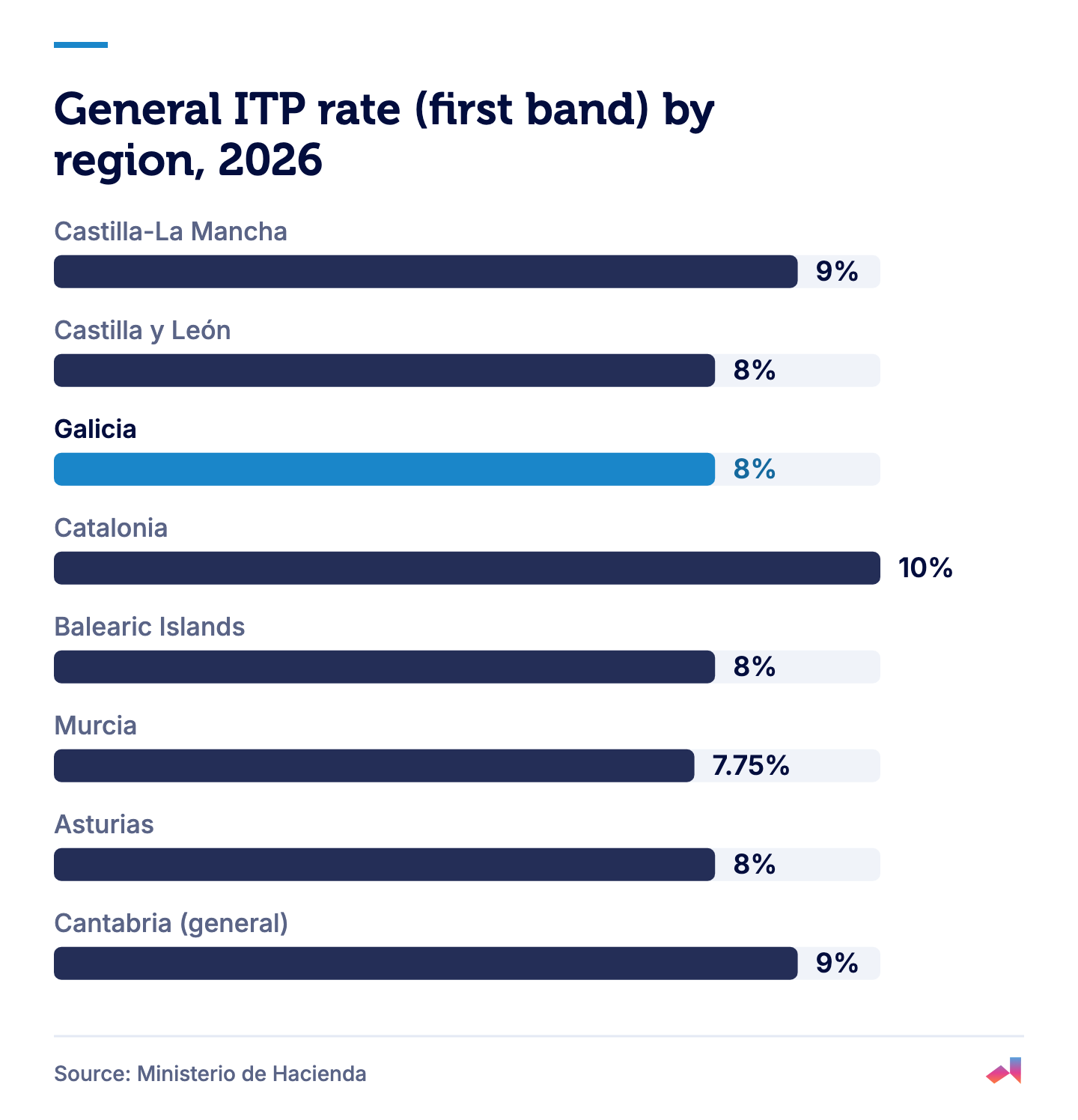
General rates in eight regions, as summarised in the Ministry of Finance's 2026 overview of regional taxes (reduced rates for specific buyers not shown):
| Region | General ITP rate |
|---|---|
| Castilla-La Mancha | 9% flat |
| Castilla y León | 8% up to €250,000, 10% on the part above |
| Galicia | 8% flat (since 1 January 2024) |
| Catalonia | 10% up to €600,000, 11% to €900,000, 12% to €1,500,000, 13% above, each on its band (since 27 June 2025) |
| Balearic Islands | 8% up to €400,000, 9% to €600,000, 10% to €1,000,000, 12% to €2,000,000, 13% above, each on its band |
| Murcia | 7.75% flat (since 25 July 2025) |
| Asturias | 8% if the value is up to €300,000, 9% up to €500,000, 10% above; one rate on the whole value |
| Cantabria | 9% general; for a main home, 7% up to €300,000 and 9% above (since 1 May 2026) |
Catalonia also applies 20% to large-scale owners (grandes tenedores). For Andalucía, Madrid, the Valencian Community and other regions, see Property purchase taxes and costs in Spain 2026. As a non-resident buyer, you must appoint a tax representative for this tax and notify the authorities within two months of buying; otherwise the home itself becomes your tax address (TRLITPAJD, art. 56).
New home bought from the developer: VAT and AJD. VAT is charged at 10%, including up to two garage spaces sold with it, outside the Canary Islands, Ceuta and Melilla (VAT law, art. 91). The deed also pays AJD (Actos Jurídicos Documentados, stamp duty on the deed) at the regional rate; the national 0.50% applies only where a region has set none (TRLITPAJD, art. 31).
Notary, Land Registry and mortgage fees: a worked example
Notary fees follow a regulated scale by bands of value, with a compulsory 5% discount; folios, copies and VAT are added (Real Decreto 1426/1989). The scale applies to the value checked by the tax office or, failing that, the value in the deed (annex II). Land Registry fees also follow a scale, with a minimum of €24.04, a maximum of €2,181.67 and a 5% discount (Real Decreto 1427/1989), paid by the person registered as owner, which in a sale means the buyer (annex II, rule 8). Unless agreed otherwise, the seller pays for granting the deed and the buyer for the first copy and everything after the sale (Civil Code, art. 1455).
Illustrative example, not a formal quote: a second-hand flat in Galicia bought for €200,000 in cash, with a reference value below the price.
| Item | Amount | Paid by |
|---|---|---|
| ITP at 8% | €16,000 | Buyer |
| Land Registry scale after 5% discount | €176.90 | Buyer |
| Nota simple online | €9.02 + VAT | Buyer |
| NIE fee | €9.84 | Buyer |
| Notary scale for the deed after 5% discount (before folios, copies, VAT) | €340.51 | Seller by default |
Subtotal for the buyer from these lines: €16,195.76, plus VAT, copies and any lawyer's fees. With a mortgage, you pay the valuation; the bank pays the gestoría (paperwork agency), the notary for the loan deed and the registration of the mortgage; copies are paid by whoever asks for them (Ley 5/2019, art. 14). AJD on a mortgage deed has been paid by the lender since 10 November 2018 (TRLITPAJD, art. 29).
To run these numbers for your own region and price, you can use the buying costs calculator and then browse listings that come with a score for your purchase project.
When the seller does not live in Spain
If the seller is non-resident with no permanent establishment in Spain, you must withhold 3% of the agreed price and pay it to the tax office (non-resident tax law, art. 25), using form 211 within one month of the sale. If it is not paid, the home remains liable for the lower of that 3% and the seller's tax (Agencia Tributaria, form 211).
The plusvalía municipal (local tax on the increase in land value) is normally the seller's, but where the seller is an individual not resident in Spain, the buyer stands in as the taxpayer before the town hall (Haciendas Locales law, art. 106). Agree in the private contract how both amounts will be handled at completion.
After you buy: Spanish and UK tax for a UK owner
IBI. The owner on 1 January owes the whole year's IBI (Haciendas Locales law, arts. 63 and 75). Each town hall sets the urban rate between 0.4% and 1.10% of the cadastral value, and the maximum can be slightly higher in provincial capitals, towns with public transport or with extra services (art. 72). Unpaid IBI from before the sale stays attached to the home (art. 64).
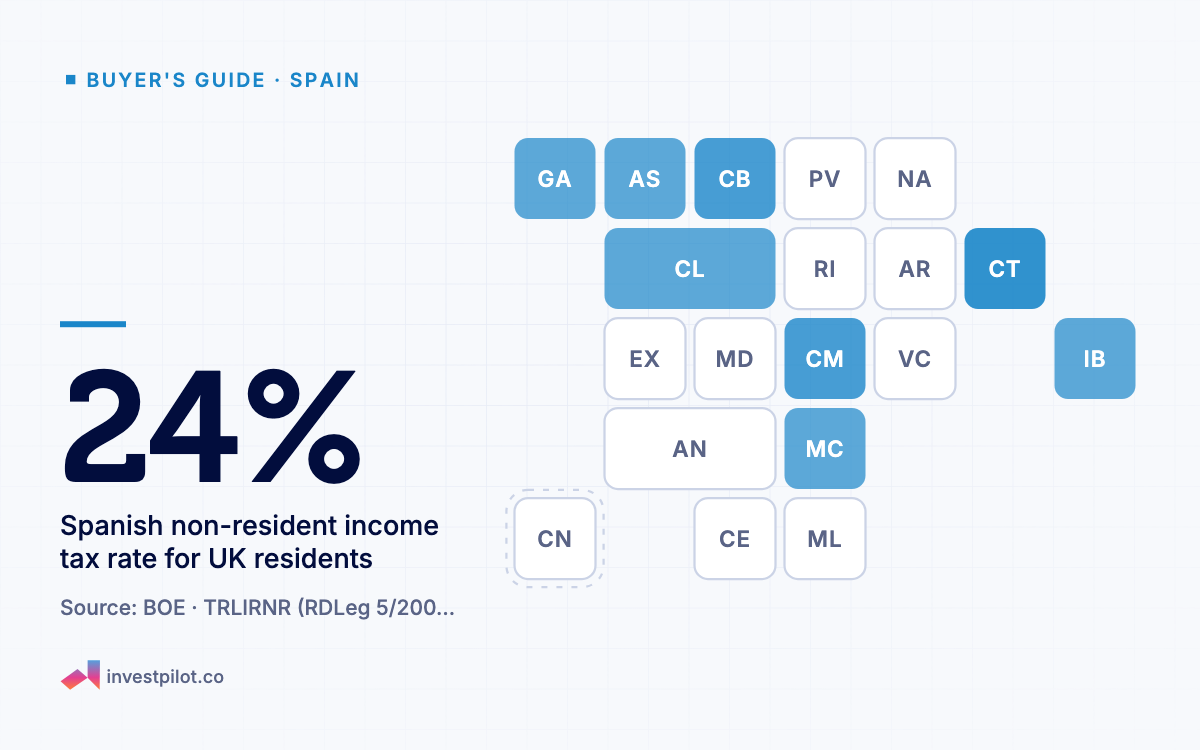
Non-resident income tax on a home you do not let. Spain taxes a notional income of 1.1% of the cadastral value if the town revised its values in the last ten years, or 2% otherwise. No expenses are deducted, the amount is prorated by days of ownership and the tax accrues on 31 December (Agencia Tributaria, non-resident manual). The general rate is 24%; the 19% rate is only for EU and EEA residents (art. 25), so UK residents pay 24%. Income for 2026 is declared on form 210 between 1 April and 31 December 2027 (Agencia Tributaria, form 210).
Illustrative example: cadastral value €80,000, values revised within ten years, owned all year. Notional income is €880 and the tax is €211.20. A decree-law in force since October 2026, Real Decreto-ley 29/2026, would replace the single percentage with a sliding scale from 1 January 2027. It amends the Spanish income tax law that non-resident tax refers to, but the tax office has not yet confirmed how it applies to non-residents, and it still needs to be ratified by the Spanish Congress, so treat it as pending.
UK side. If you are UK resident, you normally pay UK tax on foreign income, and GOV.UK gives rental income from overseas property as an example (GOV.UK, tax on foreign income). If you let the home, report that income in the foreign section of your Self Assessment return; if you do not usually file a return, tell HMRC by 5 October after the tax year concerned (GOV.UK, reporting foreign income). Where Spain has already taxed the rent, you can usually claim Foreign Tax Credit Relief, though you may not get all the Spanish tax back. If you later sell, you pay tax in both countries and the UK gives relief (GOV.UK, if you're taxed twice).
Frequently asked questions
Who pays the property transfer tax when buying a resale home in Spain?
When you buy a second-hand home in Spain, the buyer pays the transfer tax (ITP), whatever the contract says. Each region sets the ITP rate, and the national 6% rate applies only where a region has not set one.
What is the property transfer tax rate in Catalonia in 2026?
Since 27 June 2025, ITP on a second-hand home in Catalonia has been charged in bands: 10% up to €600,000, 11% up to €900,000, 12% up to €1,500,000 and 13% above that, each rate applying only to its own band. Large-scale owners (grandes tenedores) pay 20% in Catalonia.
What tax do you pay on a new-build home bought from a developer in Spain?
A new home bought from the developer in Spain is charged VAT (IVA) at 10%, including up to two garage spaces sold with it, outside the Canary Islands, Ceuta and Melilla. The buyer also pays AJD stamp duty on the deed at the regional rate, with the national 0.50% applying only where a region has set none.
Do I have to withhold 3% if the seller of my Spanish home is non-resident?
Yes. If the seller is non-resident in Spain with no permanent establishment there, the buyer must withhold 3% of the agreed price and pay it to the Spanish tax office on form 211 within one month of the sale. If that amount is not paid, the home remains liable for the lower of the 3% and the seller's tax.
How much tax does a UK resident pay in Spain on a home they don’t rent out?
Spain taxes a notional income of 1.1% of the cadastral value if the town revised its values in the last ten years, or 2% otherwise, and UK residents pay non-resident income tax on that amount at 24%. Income for 2026 is declared on form 210 between 1 April and 31 December 2027. Real Decreto-ley 29/2026 would replace the single percentage with a sliding scale from 1 January 2027, but the tax office has not yet confirmed how it applies to non-residents.
Sources
BOE · Real Decreto 1155/2024, Reglamento de extranjería, art. 205 · 2024
Policía Nacional · Asignación de NIE a instancia de interesado · 2026
Policía Nacional · Formulario tasa 790 código 012 · 2026
BOE · Real Decreto 1065/2007, art. 20 · 2007
BOE · Ley Hipotecaria, art. 254 · 1946
BOE · Ley Hipotecaria, art. 222 · 1946
BOE · Ley Hipotecaria, art. 32 · 1946
Colegio de Registradores · Registro de la Propiedad de Madrid nº 1, nota simple · 2026
Dirección General del Catastro · Preguntas frecuentes, valor de referencia · 2026
BOE · Real Decreto 390/2021, certificación energética, art. 3 · 2021
BOE · Real Decreto 390/2021, art. 17 · 2021
BOE · Real Decreto 390/2021, art. 13 · 2021
BOE · Ley 18/2007 del derecho a la vivienda (Cataluña), art. 26 · 2007
BOE · Código Civil, art. 1454 · 1889
BOE · Código Civil, art. 1280 · 1889
BOE · Código Civil, art. 1462 · 1889
BOE · Código Civil, art. 1455 · 1889
BOE · Ley 5/2019 de crédito inmobiliario, art. 14 · 2019
BOE · Ley 5/2019 de crédito inmobiliario, art. 15 · 2019
BOE · TRLRHL (RDLeg 2/2004), art. 64 · 2004
BOE · TRLRHL (RDLeg 2/2004), art. 75 · 2004
BOE · TRLRHL (RDLeg 2/2004), art. 72 · 2004
BOE · TRLRHL (RDLeg 2/2004), art. 106 · 2004
BOE · Real Decreto 828/1995, Reglamento ITP y AJD, art. 102 · 1995
BOE · TRLITPAJD (RDLeg 1/1993), art. 7 · 1993
BOE · TRLITPAJD (RDLeg 1/1993), art. 8 · 1993
BOE · TRLITPAJD (RDLeg 1/1993), art. 10 · 1993
BOE · TRLITPAJD (RDLeg 1/1993), art. 11 · 1993
BOE · TRLITPAJD (RDLeg 1/1993), art. 56 · 1993
BOE · TRLITPAJD (RDLeg 1/1993), art. 31 · 1993
BOE · TRLITPAJD (RDLeg 1/1993), art. 29 · 1993
BOE · Ley 37/1992 del IVA, art. 20 · 1992
BOE · Ley 37/1992 del IVA, art. 91 (versión 02/10/2026) · 2026
Ministerio de Hacienda · Tributación autonómica. Medidas 2026, cap. IV · 2026
Junta de Castilla y León · Tributos, transmisiones patrimoniales onerosas · 2026
Xunta de Galicia (Atriga) · Guía do imposto sobre transmisións patrimoniais onerosas · 2026
Generalitat de Catalunya (ATC) · TPO, tarifas y tipos · 2026
Govern de les Illes Balears (ATIB) · ITP, información · 2026
Región de Murcia (Agencia Tributaria) · FAQs ITPAJD · 2026
Principado de Asturias (Ente Tributario) · Guía básica de transmisiones patrimoniales · 2026
BOE · Ley de Cantabria 5/2026, de Medidas Fiscales y Administrativas para 2026 · 2026
BOE · Real Decreto 1426/1989, Arancel de los Notarios, anexo I · 1989
BOE · Real Decreto 1426/1989, Arancel de los Notarios, anexo II · 1989
BOE · Real Decreto 1427/1989, Arancel de los Registradores, número 2 · 1989
BOE · Real Decreto 1427/1989, Arancel de los Registradores, norma octava · 1989
BOE · TRLIRNR (RDLeg 5/2004), art. 25 · 2004
Agencia Tributaria · Modelo 211, instrucciones · 2026
Agencia Tributaria · Manual de Tributación de No Residentes, rentas imputadas · 2026
Agencia Tributaria · IRNR sin establecimiento permanente, modelo y plazo · 2026
BOE · Real Decreto-ley 29/2026, art. 6 · 2026
GOV.UK (HMRC) · Tax on foreign income: overview · 2026
GOV.UK (HMRC) · Tax on foreign income: reporting your foreign income · 2026
GOV.UK (HMRC) · Tax on foreign income: if you're taxed twice · 2026