
A UK resident who owns a home in Spain faces two recurring taxes once the escritura is signed. The escritura is the public deed of sale signed before a notary.
- The IBI (Impuesto sobre Bienes Inmuebles) is a local property tax paid to the town hall.
- The Spanish non-resident income tax (IRNR) is charged on an imputed income and declared with Modelo 210.
This guide explains who pays each tax, how the amount is worked out and when it is due. It is based on the official texts we read in October 2026.
The two yearly taxes at a glance
Both taxes start from the same figure, the valor catastral. This is the official value given to your home by the Catastro, Spain's official property database used for tax. The Catastro should not be confused with the Land Registry, or Registro de la Propiedad.
The Agencia Tributaria notes that the valor catastral is shown on your IBI bill. It is usually well below the price you paid.
| Tax | Collected by | Based on | Rate | Timing |
|---|---|---|---|---|
| IBI | Town hall | Valor catastral | 0.4% to 1.10%, set locally (urban property) | Owed by whoever owns the home on 1 January |
| Non-resident income tax on imputed income | Agencia Tributaria | 1.1% or 2% of the valor catastral | 24% for UK residents | Accrues on 31 December and is declared the following year with Modelo 210 |
These are yearly costs. They come on top of the one-off taxes paid when you buy, which are covered in our guide to property purchase taxes and costs in Spain 2026.
IBI: the yearly tax paid to the town hall
The IBI is paid by the holder of the right over the property, which normally means the owner (TRLRHL, art. 63.1). It accrues on the first day of the tax period, and the tax period is the calendar year (TRLRHL, art. 75). In practice, whoever owns the home on 1 January owes that year's IBI, even if they sell it a few weeks later.
The taxable base is the valor catastral (TRLRHL, art. 65). The Catastro sets this value objectively from its own records, as the sum of the land value and the building value (TRLCI, art. 22). By law it cannot exceed market value (TRLCI, art. 23.2).
A further adjustment applies to urban property in municipalities whose full valuation report was approved after 27 January 1993. In these cases, a market coefficient of 0.5 is applied to the value that comes out of that report (Order of 14 October 1998).
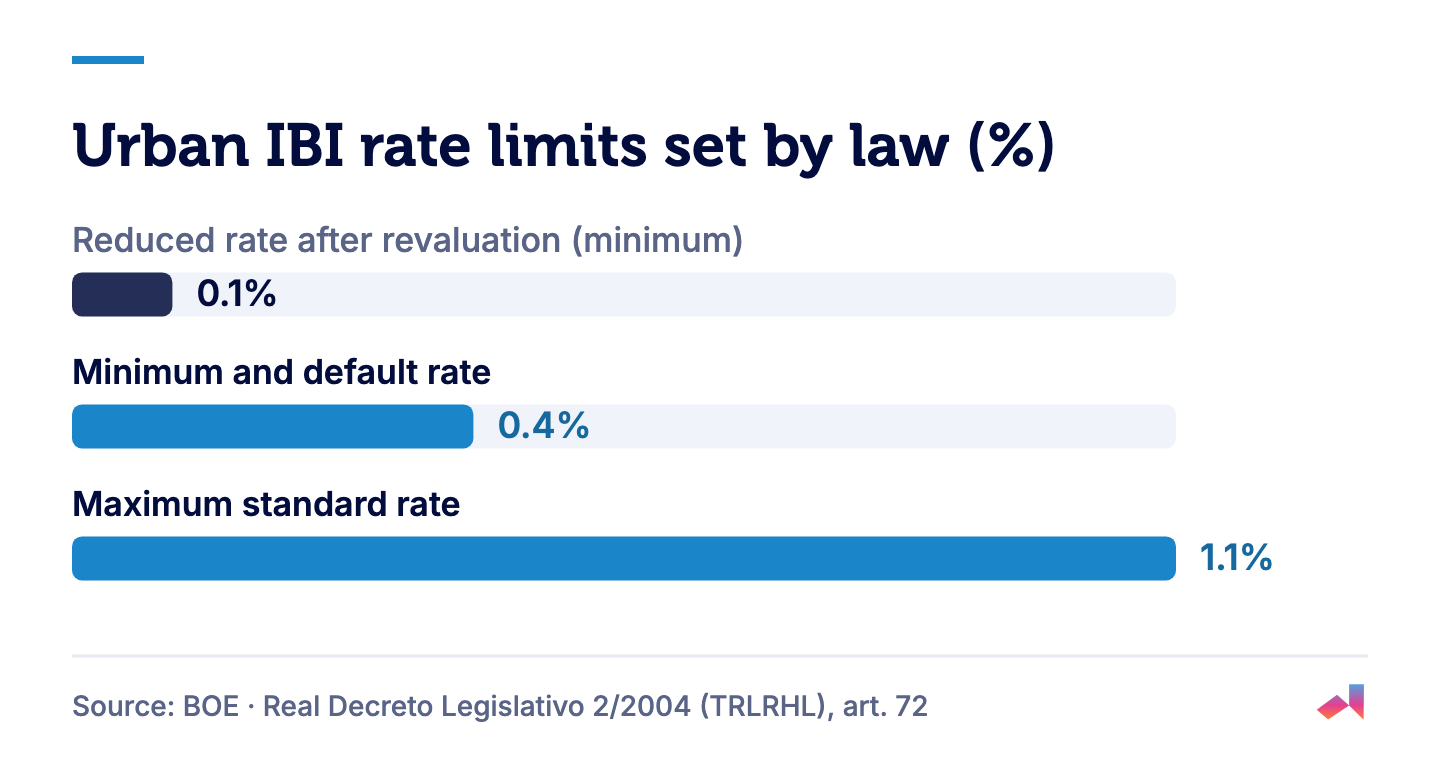
Each town hall sets its own IBI rate for urban property (TRLRHL, art. 72):
- The minimum rate is 0.4%, which also applies by default.
- The maximum rate is 1.10%.
- The maximum can be raised by 0.07 points in provincial or regional capitals.
- It can be raised by a further 0.07 points where there is public transport.
- It can be raised by 0.06 points where the town hall provides more services than it must.
After a general revaluation, a town hall may apply reduced rates for up to six years, but never below 0.1% for urban property.
IBI when you buy
Before the signing, the notary must ask for information about any IBI debts on the home. The notary must also warn both parties about these debts in the deed (TRLRHL, art. 64.1). This matters because the home itself remains liable for any unpaid IBI, and the new owner has secondary liability.
The law does not fix a day-by-day split of the year's IBI between seller and buyer. The owner who pays can pass the cost on under ordinary civil law (art. 63.2). Any sharing therefore depends on what you agree in the contract.
When a home is sold, the seller pays the municipal capital gains tax, or plusvalía municipal (art. 106.1.b). This tax is explained in taxes when selling a property in Spain 2026.
Possible reductions
Town halls may adopt IBI reductions in their tax bylaw, the ordenanza fiscal (TRLRHL, art. 74):
- up to 90% for large families;
- up to 50% for homes with solar energy installations.
These reductions are optional, so check your municipality's bylaw.
Officially protected housing (vivienda de protección oficial) is entitled to a 50% reduction on request. This applies for the three tax years after the home's final classification (art. 73.2).
For the payment window, look at your IBI bill or your town hall's tax calendar.
Non-resident income tax on a home you do not rent out
Spain taxes non-resident individuals on an imputed income from an urban home they keep for their own use or leave empty. According to the Agencia Tributaria's non-resident tax manual, this imputed income is:
- 1.1% of the valor catastral if the municipality's values were revised and came into force in the tax year or in the previous ten tax years;
- 2% in all other cases.
The same percentages appear in the income tax law that the non-resident rules refer to (LIRPF, art. 85.1). No expenses can be deducted from this income. The amount is reduced in proportion to the days you did not own the home or it was let. The tax accrues on 31 December.
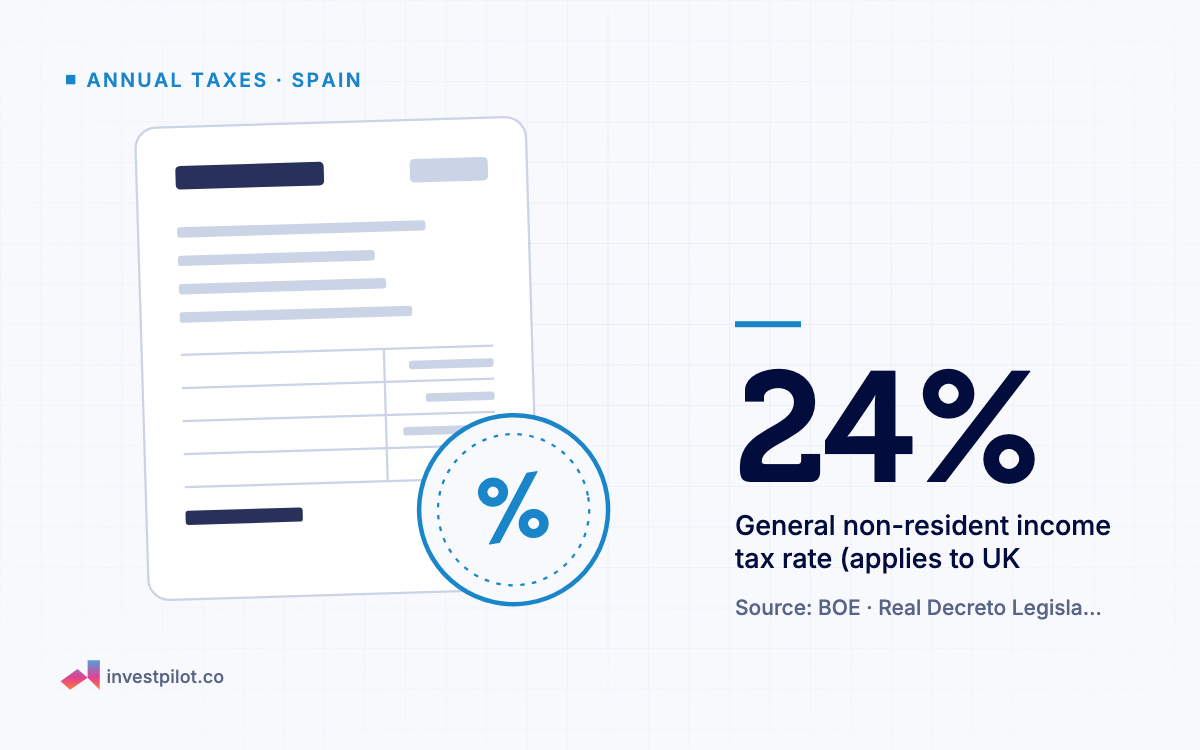
The general non-resident rate is 24%. A 19% rate applies only to residents of another EU or EEA state with an effective exchange of tax information (TRLIRNR, art. 25.1.a). The Agencia Tributaria lists the EU, Iceland, Norway and Liechtenstein for that rate. The UK is not in that group, so a UK resident pays 24%.
Point to check for 2024 to 2026
The Agencia Tributaria's manual says that in 2023, 2024 and 2025 the 1.1% rate applies where values were revised and came into force from 1 January 2012.
However, the consolidated BOE text we read in October 2026 shows that rule only for 2023. This is because Spain's Congress (Congreso de los Diputados) voted down the decrees extending it. A further extension covering 2023 to 2026, in the Real Decreto-ley 29/2026, has not yet been approved by Congress.
We do not take a view on which reading applies. Before filing for those years, including 2026 income declared in 2027, confirm the percentage for your municipality with the Agencia Tributaria or a tax adviser.
If you let the home, the imputed income is reduced for the days it was let, and the rental income is taxed separately. Our guide to short-term rentals in Spain 2026 covers what letting involves.
Worked example: a UK resident with a €100,000 valor catastral
This is a teaching example, not a calculation for any particular home. It assumes the following:
- a single owner who is UK tax resident;
- the owner holds the home for the whole year and does not let it;
- the home has a valor catastral of €100,000.
| Line | If 1.1% applies | If 2% applies |
|---|---|---|
| Imputed income | €1,100 | €2,000 |
| Non-resident tax at 24% | €264 | €480 |
For the IBI, the same example applies the standard minimum rate of 0.4% and the standard maximum of 1.10% directly to the €100,000 value. This is for illustration only and ignores any local reduction or adjustment. On that basis, the IBI would be between €400 and €1,100.
Adding the two taxes gives a yearly total between:
- €664, with 1.1% imputation and a 0.4% IBI rate;
- €1,580, with 2% imputation and a 1.10% IBI rate.
Your real figures depend on your own valor catastral, your municipality's rate and its revaluation history.
When to file Modelo 210
The imputed income is declared with Modelo 210. The filing window changed recently (Agencia Tributaria, Modelo 210 deadlines):
- Income for 2025: file from 1 January to 31 December 2026. This year is not affected by the change (Agencia Tributaria note on Order HAC/623/2026).
- Income for 2026 and later years: file from 1 April to 31 December of the following year. Income for 2026 is therefore declared between 1 April and 31 December 2027.
- Direct debit: if you pay by direct debit, the return must be filed by 23 December.
If you owned your Spanish home during 2025, the window for that year closes at the end of December 2026.
Changes in October 2026 that are still pending
The Real Decreto-ley 29/2026 has been in force since 8 October 2026. However, at the end of October 2026 the BOE did not yet show it as approved by Congress. The Constitution requires Congress to approve such a decree within 30 days.
A near-identical decree, the Real Decreto-ley 26/2026, was voted down by Congress on 2 October 2026. The measures below may therefore lapse, so treat them as pending.
- Imputed income from 2027: the single percentage would be replaced by a scale on the sum of cadastral values (art. 6). The scale would be 1.1% up to €100,000, 1.5% up to €500,000, 2% up to €1,000,000 and 3% above. The text amends the resident income tax law. The Agencia Tributaria has not confirmed how it applies to non-residents.
- IBI surcharges on tourist lets: in areas with a stressed housing market, town halls could add up to 50% to the IBI of homes used for tourist lets (art. 8). The surcharge could reach 100% for owners of two or more such homes and 150% for four or more. In practice it would apply from the 2027 IBI, and only where the town hall adopts it.
- Empty homes: the same article rewrites the surcharge on homes left empty for more than two years without good reason. A second home counts as a valid reason for up to four years of continuous vacancy.
The UK side and your overall budget
GOV.UK states that if you are UK resident you normally pay UK tax on your foreign income. It gives rental income on overseas property as an example. If you are not UK resident, you do not pay UK tax on foreign income (GOV.UK, Tax on foreign income).
If you let your Spanish home, you report the rent in the ‘foreign’ section of your Self Assessment tax return. If you do not usually file a return, you must tell HMRC by 5 October after the tax year concerned (GOV.UK, reporting foreign income).
Where Spain has already taxed that income, you can usually claim Foreign Tax Credit Relief. However, you may not get back the full amount of Spanish tax (GOV.UK, if you're taxed twice).
The GOV.UK pages we read do not cover Spanish imputed income on a home you do not let. Ask HMRC or a UK adviser how it applies to you.
To see these yearly costs alongside the one-off costs of buying, you can work out the buying costs in the calculator. It covers the ITP (property transfer tax) for each region, mortgage repayments and the cash you need.
Sources
BOE · Real Decreto Legislativo 2/2004 (TRLRHL), art. 63 · consolidated text 2026
BOE · Real Decreto Legislativo 2/2004 (TRLRHL), art. 64 · consolidated text 2026
BOE · Real Decreto Legislativo 2/2004 (TRLRHL), art. 65 · consolidated text 2026
BOE · Real Decreto Legislativo 2/2004 (TRLRHL), art. 72 · consolidated text 2026
BOE · Real Decreto Legislativo 2/2004 (TRLRHL), art. 73 · consolidated text 2026
BOE · Real Decreto Legislativo 2/2004 (TRLRHL), art. 74 · consolidated text 2026
BOE · Real Decreto Legislativo 2/2004 (TRLRHL), art. 75 · consolidated text 2026
BOE · Real Decreto Legislativo 2/2004 (TRLRHL), art. 106 · consolidated text 2026
BOE · Real Decreto Legislativo 1/2004 (TRLCI), art. 22 · consolidated text 2026
BOE · Real Decreto Legislativo 1/2004 (TRLCI), art. 23 · consolidated text 2026
BOE · Orden de 14 de octubre de 1998, coeficiente RM · 1998
BOE · Real Decreto Legislativo 5/2004 (TRLIRNR), art. 25 · consolidated text 2026
BOE · Ley 35/2006 del IRPF, art. 85 · consolidated text 2026
BOE · Real Decreto-ley 29/2026 · 2026
BOE · Real Decreto-ley 29/2026, art. 6 · 2026
BOE · Real Decreto-ley 29/2026, art. 8 · 2026
BOE · Real Decreto-ley 26/2026, document analysis · 2026
Agencia Tributaria · IRNR sin establecimiento permanente: modelo y plazo de declaración · 2026
Agencia Tributaria · Nota sobre plazos del modelo 210 (Orden HAC/623/2026) · 2026
GOV.UK (HMRC) · Tax on foreign income: overview · 2026
GOV.UK (HMRC) · Tax on foreign income: reporting your foreign income · 2026
GOV.UK (HMRC) · Tax on foreign income: if you're taxed twice · 2026